Is it safe to put client files into Claude or ChatGPT?
Your staff are probably already using AI on client work. Here’s what the plans actually do with your data, what the ABA expects, and how to put guardrails in place this week.
The short answer
It can be, on the right plan, with the right diligence, and with a firm policy. Business plans from Anthropic and OpenAI don’t train on your data by default. Personal plans are a different story, and the biggest real-world risk is staff pasting client files into personal accounts. Under ABA Formal Opinion 512, the firm also has to understand how any AI tool handles confidential information, supervise its use, and verify the output.
Training is only one of the questions. Where the data goes, who can access it, and who checks the result matter just as much. This guide walks through all of them. It’s general information, not legal advice; your state bar may have its own guidance.
Does Claude or ChatGPT train on your firm’s data?
It depends on the plan, as of October 19, 2026:
| Plan | Used to train models? |
|---|---|
| Claude Free, Pro, Max (personal) | Only if the user allows it in privacy settings, or if a chat is flagged for safety review, according to Anthropic. |
| Claude for Work and Anthropic API (business) | Not by default. Feedback a user submits can be used. |
| ChatGPT personal plans | Governed by each user’s own data controls. Check the setting on every account. |
| ChatGPT Business, Enterprise, and API | Not by default. Data shared through opt-in feedback can be used. |
The practical takeaway: if anyone at your firm uses AI for client work, it should be on a business plan the firm controls, not a personal account someone signed up for on their own.
What ABA Formal Opinion 512 asks of your firm
The ABA’s July 2024 opinion on generative AI applies existing ethics rules. In plain English:
- Competence (Rule 1.1). Understand what the tool can and can’t do well enough to use it responsibly, and keep up as it changes.
- Confidentiality (Rule 1.6). Evaluate the risk that client information could be disclosed or accessed. Read the vendor’s terms and privacy policy, or have someone qualified do it. For tools that learn from what you put in, the opinion says informed client consent is required first, and boilerplate in an engagement letter isn’t enough.
- Communication (Rule 1.4). Depending on the situation, you may need to tell clients you’re using AI on their matter.
- Candor and meritorious claims (Rules 3.1, 3.3). Verify what the AI produces before relying on it, especially citations.
- Supervision (Rules 5.1, 5.3). Partners need clear policies and training for lawyers and staff, and should vet the vendors the firm uses.
- Fees (Rule 1.5). Bill for the time actually spent. Time saved by AI can’t be billed as if it hadn’t been.
The risks that actually bite firms
- Personal accounts. A paralegal pastes a medical record into a free chatbot because it’s fast. No policy, no business plan, no visibility.
- Connectors on personal accounts. Hooking a case management system into an individual’s AI account gives that account the person’s full access, with the firm unaware.
- Unverified output. A confident summary that’s missing a treatment gap, or a citation that doesn’t exist, reaching a client or court.
- Homegrown connectors. Community code that holds credentials to your client files, with no vendor accountable for it.
Eight questions to ask any AI vendor
- Where is our data processed and stored?
- Is our data kept separate from other firms’ data?
- Is it used to train models, by default or ever?
- Who at the vendor can access it, and when?
- How long is it retained, and can we delete it?
- Whose permissions does the AI use in our systems, and how do we revoke access?
- What can it do without a person approving it?
- Who reviews the output before it reaches a client, court, or insurer?
A five-rule AI policy you can adopt this week
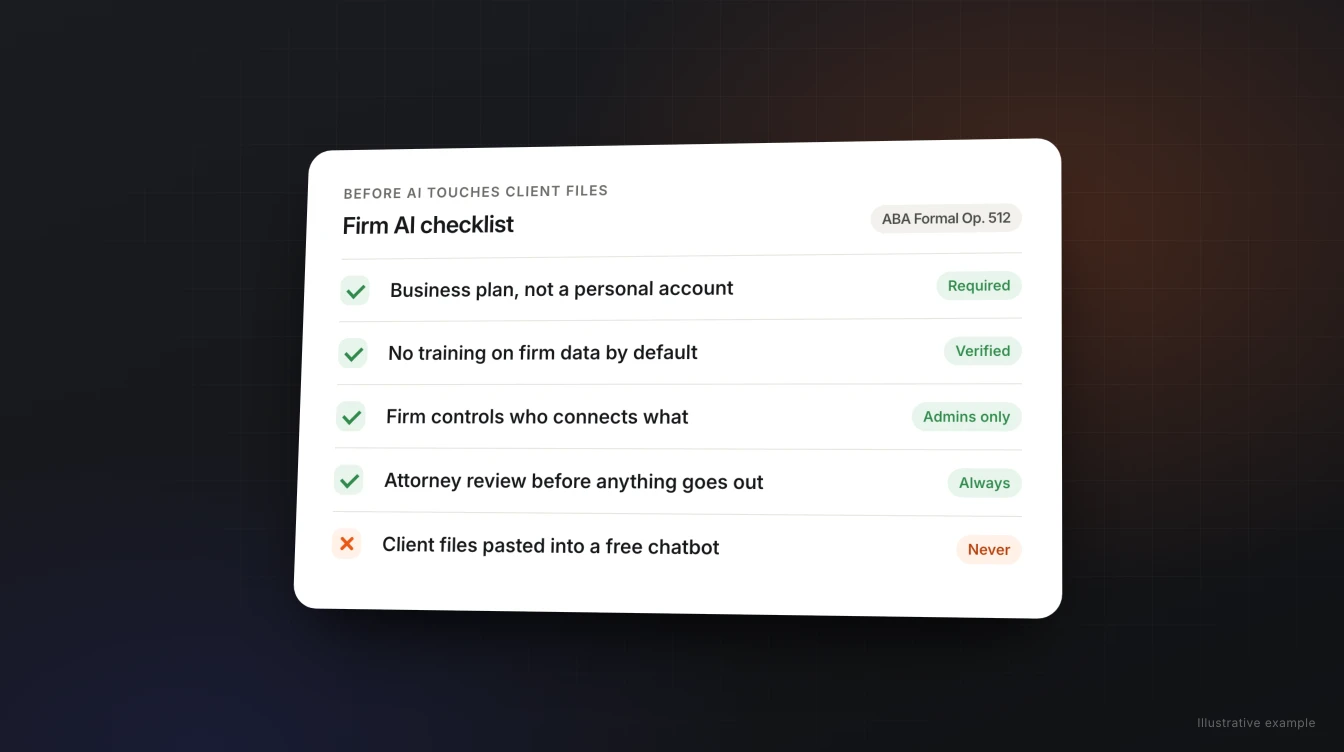
- Firm-approved tools only. No client information in personal AI accounts.
- Business terms required. Approved tools must not train on firm data by default.
- Connections are firm-managed. Only designated admins connect AI to case management or email.
- Attorneys verify everything. No AI output goes to a client, court, or insurer without attorney review.
- Know when to tell the client. Decide when your engagement letters and client communications should address AI use.
How Parker answers these questions
- A dedicated server for each firm. Your Parker runs on its own server, reserved exclusively for your firm. No other firm’s Parker runs on it.
- No training on your data. Your case files, conversations, and firm knowledge are used to do your work. We don’t train models on any of it.
- Firm-controlled access. Your firm decides which accounts Parker connects to and who can use each connection.
- Attorneys stay responsible. Parker prepares drafts and analysis. Your attorneys check facts, citations, and judgment before anything is filed or sent.
Read more about security at Parker.
Frequently asked questions
Does Claude train on my law firm’s data?
On Anthropic’s business products, such as Claude for Work and the Anthropic API, inputs and outputs aren’t used for training by default. On personal plans (Free, Pro, Max), chats are used only if the user allows it in privacy settings or if a chat is flagged for safety review, according to Anthropic.
Does ChatGPT train on my law firm’s data?
OpenAI says it does not train on data from ChatGPT Business, ChatGPT Enterprise, or its API by default. Personal ChatGPT accounts are governed by each user’s own data controls, so firm work should stay on a business plan the firm controls.
What does ABA Formal Opinion 512 require?
Issued in July 2024, it applies existing rules to generative AI: competence, confidentiality, client communication, candor and verification, supervision, and reasonable fees. For self-learning tools, it says informed client consent is required before entering information relating to the representation, and boilerplate engagement-letter language isn’t enough.
Do we need client consent to use AI?
It depends on the tool and the situation. ABA Formal Opinion 512 calls for informed consent before putting client information into tools that learn from it. Check your state bar’s guidance as well. This article is general information, not legal advice.
Does Parker train models on our data?
No. Parker uses your case files, conversations, and firm knowledge to do your work, and we don’t train models on any of it. Each firm also gets its own dedicated server.
Who reviews Parker’s work?
Your attorneys. Parker prepares drafts and analysis; attorneys check facts, citations, and judgment before anything is filed or sent.
Sources
- ABA Formal Opinion 512: Generative Artificial Intelligence Tools (July 29, 2024)
- Anthropic Privacy Center: Is my data used for model training? (commercial products) (updated August 18, 2026)
- Anthropic Privacy Center: Is my data used for model training? (consumer products) (updated March 16, 2026)
- OpenAI: Enterprise privacy (updated January 8, 2026)
AI your firm can actually govern.
A dedicated server, no training on your data, firm-controlled access, and attorney review on every draft.