Best AI for plaintiff law firms (2026): five options compared
Every plaintiff-firm AI vendor promises more cases and better settlements. The real differences are where your team works, what the AI connects to, and what happens without anyone asking.
The short answer
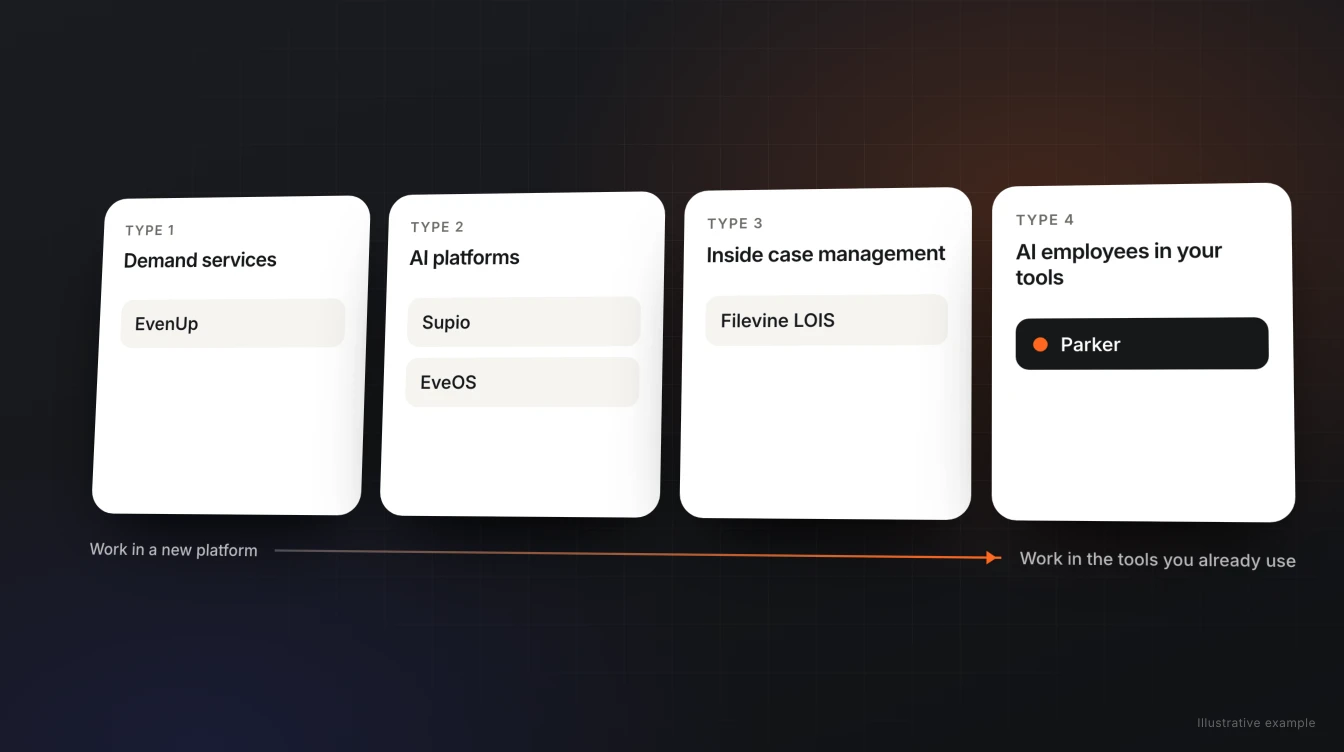
There isn’t one best AI for every plaintiff firm, because the leading tools are built in four different ways. Some are services built around demand packages (EvenUp). Some are platforms your team works inside (Supio, EveOS). One is built into a case management system (Filevine’s LOIS). And some are AI employees that work across the systems you already have (Parker).
Pick the category first, then the product. If you want AI to do casework inside the tools your team already uses, without moving to a new platform, start with the last group. That’s where Parker sits.
Five options at a glance
Each description below uses the vendor’s own published words as of November 11, 2026. We’ve left out vendor-reported results like settlement increases, which we can’t verify.
| How it describes itself | Where your team works | Case management it names | |
|---|---|---|---|
| EvenUp | “Proactive AI platform for the entire case lifecycle,” known for demands and medical chronologies | EvenUp’s platform and services | Litify, SmartAdvocate, and CASEpeer, “and more.” Clio, Filevine, and MerusCase aren’t named. |
| Supio | “Agentic legal AI platform built for plaintiff law and mass torts” | Supio’s platform | Litify, SmartAdvocate, MyCase, CASEpeer, Smokeball, Jove, and Neostella. Clio, Filevine, and MerusCase aren’t named. |
| EveOS | “The AI operating layer for plaintiff lawyers,” with intake, auditing, drafting agents, and firm analytics | EveOS, as a primary system or alongside an existing one | SmartAdvocate and Lead Docket; also lists Litify and Clio Grow. Clio Manage, Filevine, and MerusCase aren’t named. |
| Filevine LOIS | “Legal AI that runs the firm,” with firm-wide agents inside Filevine | Filevine | Filevine |
| Parker | An AI employee for plaintiff firms that hands back drafts and analysis for attorney review | Web chat, email, and Slack | Clio, Filevine, MerusCase; new integrations within 48 hours |
The four kinds of plaintiff-firm AI
1. Built around demand packages: EvenUp
EvenUp made its name on AI-assisted demand packages and medical chronologies for personal injury firms, and now pitches a platform for the whole case lifecycle, from intake through trial. It offers both instant AI demands and “legal-reviewed” demands, depending on case type. A fit if demands are your biggest bottleneck and you’re comfortable sending work into an outside platform.
2. Platforms you work inside: Supio and EveOS
Supio and EveOS both ask your team to work in their environment. Supio emphasizes an agent that works across every case, plus intake and case communications. EveOS bundles intake, a nightly auditor of active matters, drafting agents, and firm analytics. A fit if you want one new system to become the center of your AI work and you’re ready to train the team on it.
3. Built into your case management: Filevine LOIS
Filevine’s LOIS runs agents across your Filevine matters, with research and drafting tools alongside. A fit if your firm is all-in on Filevine and plans to stay there. If your work also lives in email, shared drives, or a second system, it covers only part of the picture.
4. An AI employee in your existing tools: Parker
This kind doesn’t ask your team to move anywhere. It connects to the case management, email, and documents you already use and takes work off your plate. A fit if you want AI to work like a team member, not a new destination.
Where Parker fits
Parker is in that last group, and here’s what sets it apart:
- A dedicated server for each firm. Your firm’s Parker runs on its own server, reserved exclusively for your firm, and we don’t train models on your data.
- MerusCase support. Parker works with MerusCase, which matters for workers’ compensation firms, alongside Clio and Filevine.
- Work where your team already talks. Assign work by web chat, email, or Slack, and get the result back in the same place.
- Your choice of AI models. Parker supports frontier and open-source models, so you aren’t locked to one provider.
- A team that sets it up with you. We help choose workflows and connect your systems, and can add a new integration within 48 hours.
- Breadth of casework. Discovery responses, complaints, demands, motions, chronologies, case summaries, evaluations, case audits, and mediation preparation, all for attorney review.
How to choose: six questions for every vendor
- Where does my team do the work? In a new platform, or in the tools they already use?
- Which of our systems does it actually connect to? Ask for your case management system by name, plus email and document storage.
- What happens without anyone asking? Recurring audits, stage-triggered drafting, overnight reviews, or nothing until someone types?
- Is our data isolated and kept out of model training? Get it in writing.
- Who reviews the output? Your attorneys, the vendor’s staff, or both?
- How is it priced? Per user, per firm, per case, or per document, and what happens as you grow?
Frequently asked questions
What is the best AI for a personal injury firm?
It depends on where you want the work to happen. EvenUp is known for demand packages, Supio and EveOS are platforms your team works inside, Filevine LOIS is built into Filevine, and Parker works across the systems you already use. Start by choosing the kind of tool, then compare products.
What’s the difference between an AI platform and an AI employee?
A platform asks your team to do its AI work in a new system. An AI employee connects to the case management, email, and documents you already use, takes assignments, and hands back work in the same tools.
Does Parker work with MerusCase?
Yes. Parker connects to MerusCase, Clio, and Filevine, plus email, Slack, Google Workspace, Microsoft 365, and Dropbox. We can add a new integration within 48 hours.
Is Parker only for personal injury?
No. Parker supports plaintiff-side work across personal injury, employment, workers’ compensation, and consumer matters.
How is Parker priced?
You can get started for free. For firm-wide setup, we walk through pricing on a demo along with your tools, templates, and the workflows you want to hand off first.
Do attorneys still review AI-drafted work?
With Parker, yes. Parker prepares drafts, analysis, and next steps. Your attorneys check facts, citations, and judgment before anything is filed or sent.
Sources
- EvenUp homepage (checked November 11, 2026)
- EvenUp: Integrations (checked November 11, 2026)
- Supio homepage (checked November 11, 2026)
- Supio: Integrations (checked November 11, 2026)
- Eve homepage (checked November 11, 2026)
- Eve: Platform (checked November 11, 2026)
- Filevine homepage (checked November 11, 2026)
See where Parker fits in your firm.
Bring one workflow you want off your plate and see Parker handle it with your tools and templates.